
Off-Grid Integrated EV Charging Solution
- Home
- Off-Grid Integrated EV Charging Solution
Integrated Solution
Off-Grid Integrated EV Charging Solution
A continuous, high-throughput remote EV charging station delivered as a single skid-mounted microgrid. It pairs solar and renewables with a biofuel genset, the UON SMART™ CELL battery and the UON DC-FC dispenser to deliver fast, reliable charging anywhere – on-grid, grid-constrained or fully off-grid – eliminating the depletion bottleneck of standalone battery systems.
An integrated, skid-mounted microgrid architecture that combines energy storage, power distribution and the vehicle interface into one smart, self-contained system – engineered to sustain a 100% duty cycle in Australia’s harshest remote environments.
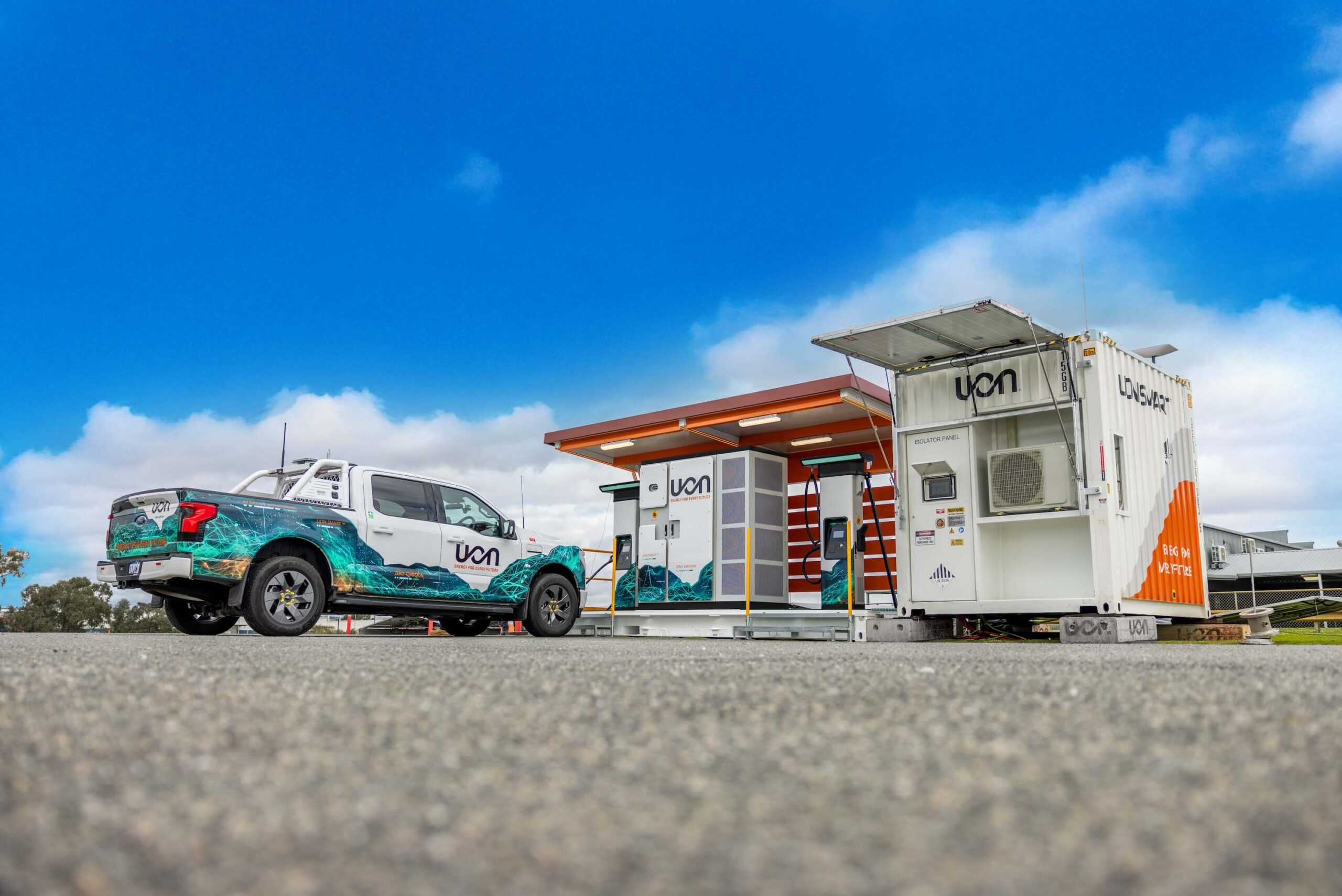
System Configuration Overview
Solar and renewables are DC-coupled into the SMART CELL battery bank, and the biofuel genset feeds the same battery bank in parallel – regulated in real time by UON’s patented Generator Motor Controller (GMC), which balances battery state-of-charge against live charging demand.
Technical Specification & Asset Mapping
Primary Energy Storage
UON SMART CELL – a 200 kWh liquid-cooled lithium iron phosphate (LFP) battery bank, engineered to sustain a 100% duty cycle up to 50°C ambient with zero thermal derating.
Dispensing Infrastructure
UON DC-FC – a 100 kW dual-plug heavy-duty dispenser that draws high-power demand directly from the SMART CELL’s internal DC bus, preventing local AC grid sag.
Dynamic Power Backup
100 kW prime-rated biofuel genset (B100/HVO-certified) on the same transport skid, with Viton seals and inline fuel heaters for 100% biodiesel/HVO – a closed lifecycle carbon loop, sequenced by the UON GMC.
The Power Problem
The constraint
A remote charging station has to run around the clock, but the only continuous outside power is a 22 kW grid connection. The on-site buffer is a 200 kWh battery. Say for example, each dispenser delivers up to 100 kW – split as 50 kW + 50 kW when two vehicles charge together. With 10 sessions between 7 am–7 pm and another 10 between 7 pm–7 am (≈50 kWh each), how long does the battery actually last?
A 236 kWh gap every 12 hours
| Energy out (10 × 50 kWh) | 500 kWh |
| Grid in (12 h × 22 kW) | 264 kWh |
| Net deficit | −236 kWh |
The battery has to bridge that gap – but at 200 kWh it cannot cover even a single 12-hour block.
How long the battery lasts
Spread evenly, 10 sessions over 12 hours is an average draw of 41.67 kW. With 22 kW flowing in, the battery drains at a net 19.67 kW. Starting full at 7 am:
200 kWh ÷ 19.67 kW ≈ 10.2 hours — flat by about 5:10 pm
The last one or two afternoon vehicles get throttled to grid pass-through, and the night shift begins with an empty buffer.
The 24-hour verdict
| Demand (20 × 50 kWh) | 1,000 kWh/day |
| Grid (24 h × 22 kW) | 528 kWh/day |
| Daily shortfall | −472 kWh/day |
A 22 kW grid and a 200 kWh battery are structurally undersized for 24/7 service at this demand. The battery is a buffer, not a source – it smooths peaks but cannot manufacture missing energy.
Closing the gap
The fix is more energy in, not more storage: a larger grid feed (~42 kW to match average draw), an on-site solar array, or a prime-rated genset – exactly what the integrated off-grid architecture delivers.
When an EV plugs into the UON DC-FC and demands 100 kW, the energy is drawn directly from the 200 kWh SMART CELL. The backup genset remains completely powered off, achieving zero tailpipe emissions. The system sustains two back-to-back 50 kWh passenger-vehicle fast-charging sessions purely on stored energy (assuming no concurrent solar input) before reaching the critical threshold.
The moment the SMART CELL drops to 30% SoC (60 kWh remaining), the GMC signals the biofuel genset to start. Because the genset delivers a matched 100 kW output, it feeds the microgrid in real time: with the EV pulling 100 kW and the genset simultaneously pushing 100 kW, the net load on the battery is 0 kW. The pack stabilises exactly at 30% SoC for the rest of the session – eliminating any risk of station depletion or vehicle throttling.
Once the vehicle unplugs and demand drops to zero, the GMC keeps the genset running at its optimal peak-efficiency curve rather than light-loading it, redirecting full capacity to recharge the 200 kWh SMART CELL to a safe operational buffer (e.g. 80% SoC). Once the target is reached, the GMC cleanly shuts the genset down, returning the station to silent, standby readiness.
Why This Solution
- Continuous, infinite throughput – pairing the 200 kWh battery with a perfectly matched 100 kW generator means the station never experiences downtime; it charges vehicles back-to-back all day, regardless of how weak or non-existent the local grid is – unlike battery-only chargers that need long hours of grid trickle-charging once empty.
- Zero battery degradation from micro-cycling – the GMC logic never allows the pack to deep-discharge below 30% SoC, maximising the operational lifespan (state of health) of the cells.
- True lifecycle net-zero – because the generator burns sustainably sourced biodiesel or HVO, its combustion is classified as biogenic carbon, letting mining, agricultural and transport-fleet operators run 24/7 heavy-vehicle charging while reporting zero Scope 1 CO₂ emissions under national greenhouse-accounting frameworks.